The lights explained¶
XPGuard draws five kinds of guidance light in your sim, live over VATSIM.
You read the lights. You never switch them. They are driven for you:
- A controller drives the stop bars, their lead-on greens, and FTG.
- The ground-radar picture drives the automatic lights (THL and REL).
- The plugin in your sim only reflects whatever the server says.
This page is the concept reference. For setup and per-sim details, see:
| Light | What it is | Who drives it | Colours |
|---|---|---|---|
| Stop bars | Red lights across a taxiway at a holding position | A controller switches each bar | Red / dark |
| Lead-on/off lights | A green or green+amber centerline route beyond a stop bar, along the cleared path | The controller's clearance of its bar (EuroScope) | Green (green/amber for the ILS critical area) / dark |
| Takeoff Hold Lights (THL) | A double row down the runway centerline ahead of a lined-up departure | Automatic, from the ground-radar picture | Red / dark |
| Runway Entrance Lights (REL) | A red row from a holding position to the runway edge | Automatic, once a controller claims REL for the runway | Red / dark |
| Follow the Greens (FTG) | A moving green centerline route to taxi along | A controller draws and sends the route | Green / dark |
There is no green all-clear
Except for the greens — the FTG route and the lead-on lights — there is no green state.
- A light going dark means only that XPGuard sees no restriction.
- Dark is never a clearance.
- Your clearance to cross, enter, taxi or take off always comes verbally from ATC.
Stop bars¶
Red lights across a taxiway at runway and apron holding positions. They are detected automatically at every airport. There is no per-airport setup for the pilot.
| State | Meaning |
|---|---|
| Red | Hold short — do not cross (first figure below). |
| Dark | No restriction from this bar. There is no green state (second figure below). |
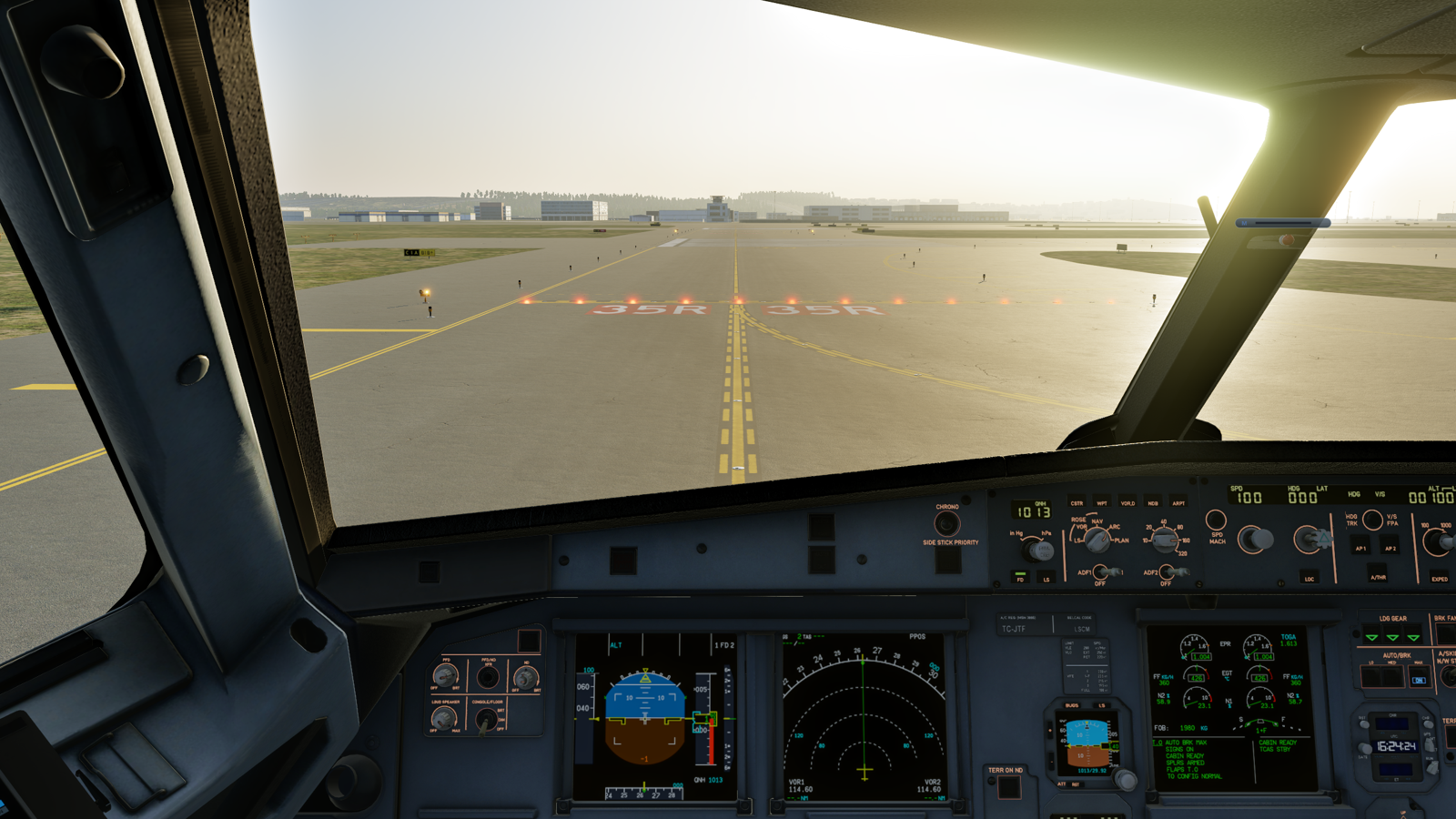
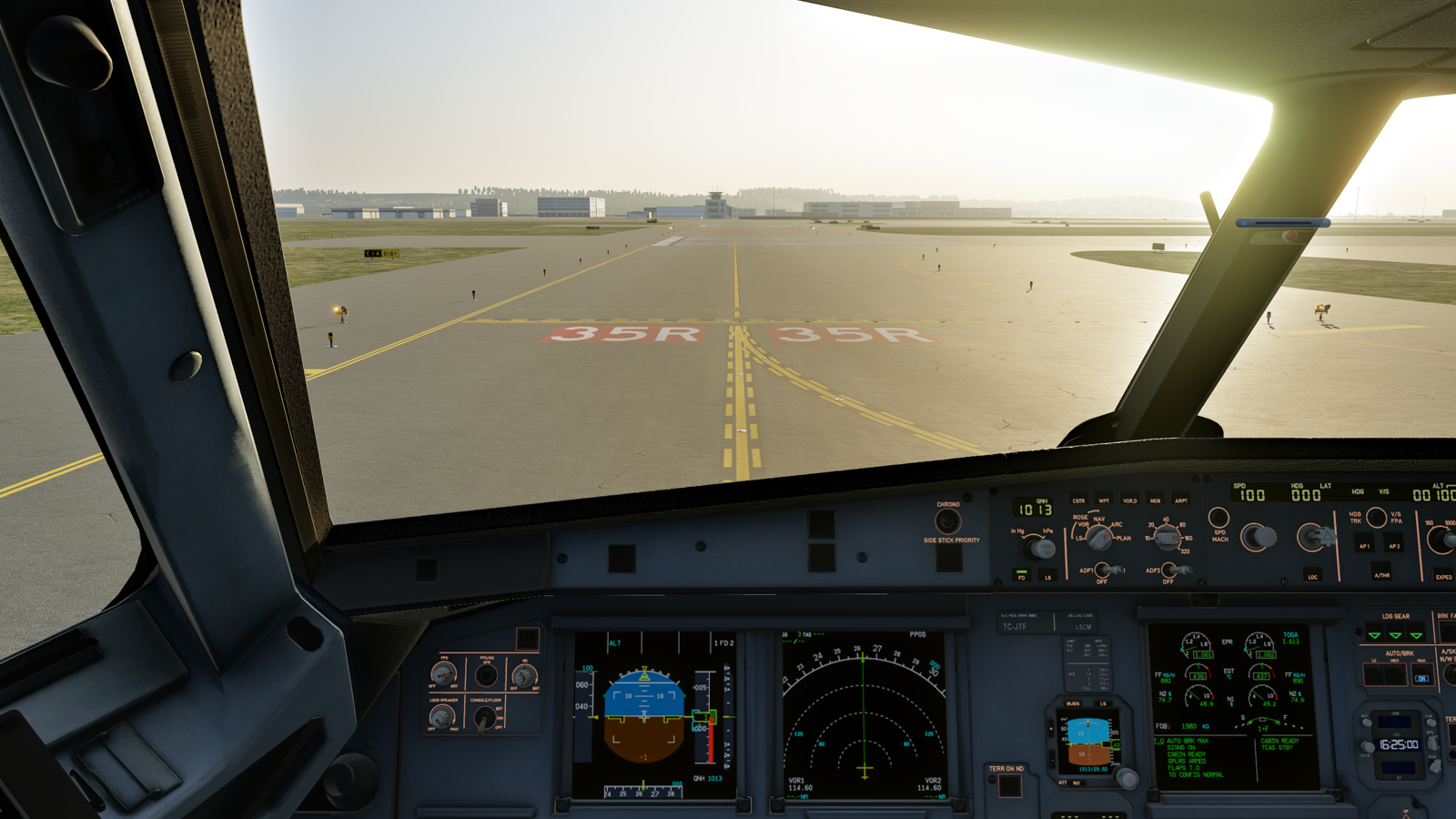
What to know:
- A controller switches each bar on or off from their radar.
- You never toggle a bar yourself. The plugin reflects the controller's state.
- A bar with no controller online is also dark (no-entry bars excepted). Check
Controlled by …in your sim's panel. - A bar sitting slightly off the scenery markings can be fixed with a community correction.
A dark stop bar is not a crossing clearance
The lights are an aid. Your crossing clearance always comes verbally from ATC.
Per-bar Default / LVP states¶
Larger airports have a second, farther-back holding position on many entries. That is the CAT II/III holding position, which protects the ILS critical area in low visibility.
So every stop bar carries a Default / LVP state, set by the mapper in the editor. It decides when the bar lights: in normal operations, in Low Visibility Procedures, in both, or neither.
| State | Normal ops | LVP on | Typical use |
|---|---|---|---|
| ON | Lit | Lit | A regular hold-short bar (the default). |
| Non-LVP only | Lit | Dark | CAT I holding position. |
| LVP only | Dark | Lit | CAT II/III holding position. |
| OFF | Dark | Dark | Off in both regimes; switched by hand when needed. |
As in the real procedure, only the holding position in use is lit. When a controller turns LVP on for the runways they hold:
- Every
LVP onlybar lights. - Every
Non-LVP onlybar goes out. - So an aircraft cleared past the CAT II/III bar never faces a lit bar inside the critical area.
ONbars are untouched, and a controller can still switch any bar by hand.
Full controller detail is on the EuroScope page.
No-entry bars¶
New in 1.4.0
No-entry bars are a new bar property in XPGuard 1.4.0.
A no-entry bar marks a place that must never be entered — a one-way lane, a closed taxiway link, a stand entrance you may only leave by. It follows ICAO Annex 14 §5.3.24.
- It is permanently red. It is a property of the bar, not a switchable state.
- No controller can toggle it. The server pins its status red for everyone, and the controller plugins refuse to make it a click target.
- A no-entry bar can be tied to one regime through its Default / LVP state. An
LVP onlyno-entry bar is pinned red only while LVP is on; in normal ops it is an ordinary, switchable bar.Non-LVP onlyis the reverse.ONbars are no-entry in both.
Lead-on/off lights¶
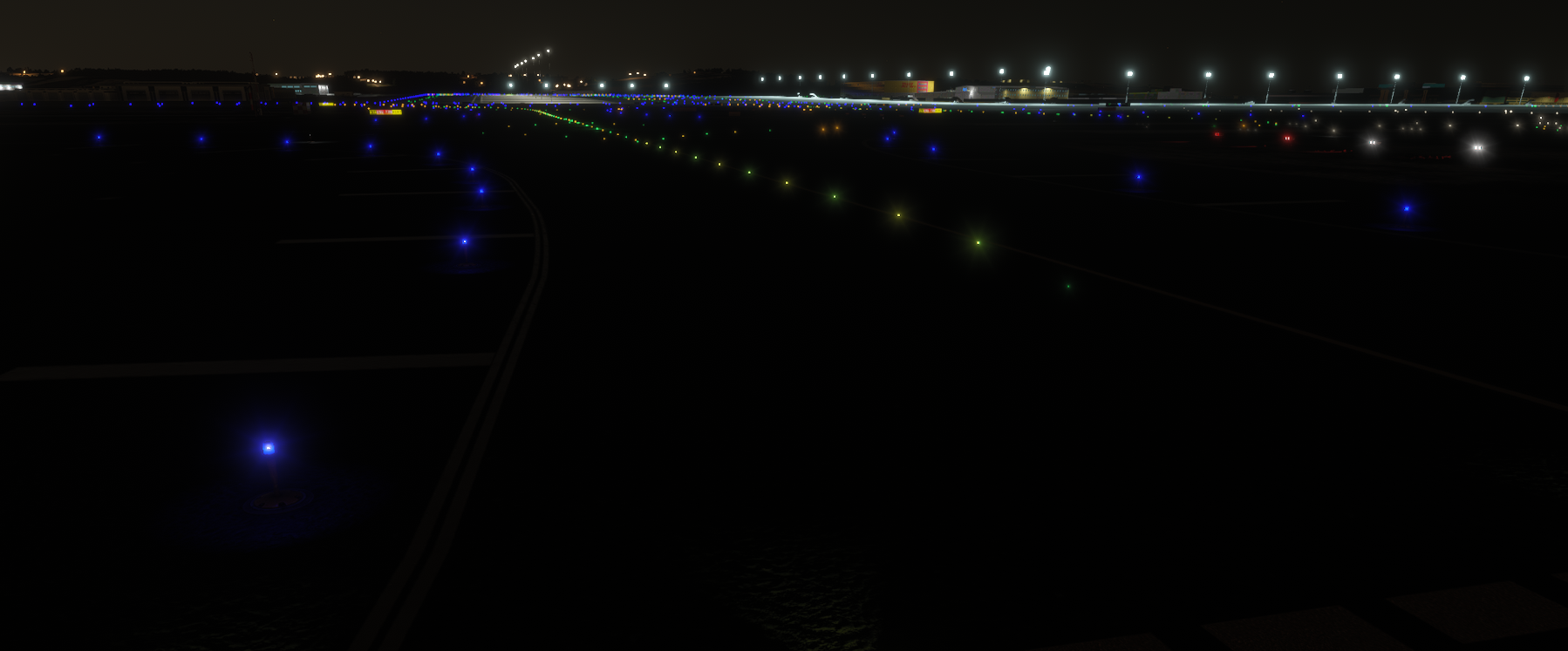
Controllers: there is a video tutorial on switching these from EuroScope.
A line of green or green+amber centerline lights beyond a stop bar, along one route — onto the runway, or across it. When the controller clears the bar for you, the greens for your route light with it.
| State | Meaning |
|---|---|
| Green | The route the bar was cleared for. Follow it. |
| Green / amber alternating | Same route, inside the ILS critical area — clear it fully before stopping. |
| Dark | The bar has not been cleared for this route — or your controller's client does not drive lead-on. |
What to know:
- A bar can carry several lines — one or more per departure runway end, plus one for crossing. Only the line you were cleared for lights; the others stay dark.
- A route onto the runway ends at the runway centerline. A crossing runs across in one continuous line to the far side.
- Lead-off: vacating the runway after landing, steady greens or green+amber lights along the exit guide you out. A stop bar forbids entry, never exit, so these are not switched by your bar. The controller can limit them to the runways in use for landing.
- With no ATC controlling the bar, all the lead-on/off lines belonging to the bars will be lit.
Green marks the route, not the permission
The greens show where the clearance goes. The clearance itself is what ATC said — if the lights disagree with what you were told, ask.
Where it shows
Lead on/off lights are availale at only contributed, published airports. See Mapping lead-on lines.
Takeoff Hold Lights (THL)¶
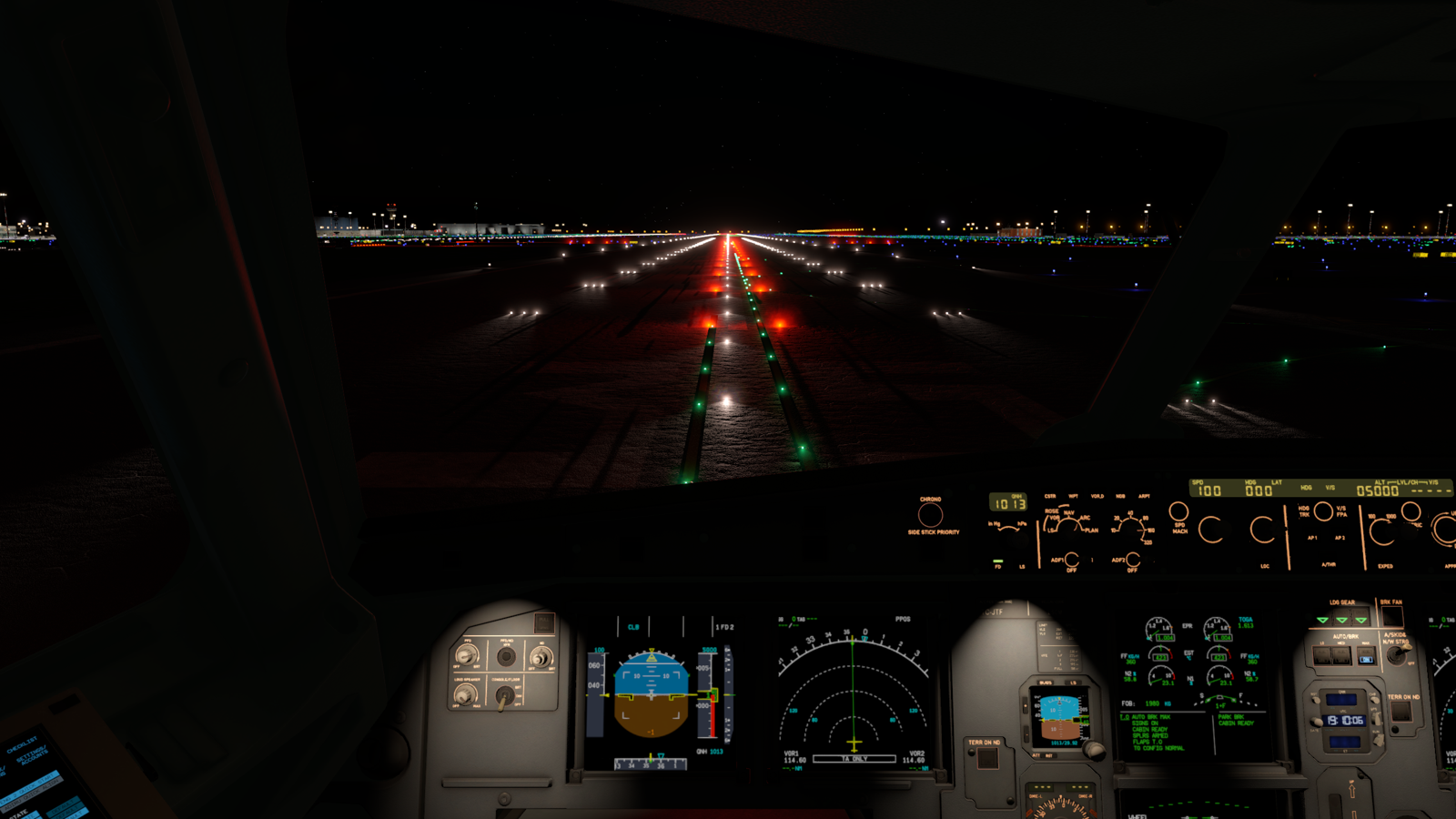
A double row of red in-pavement lights down the runway centerline, ahead of an aircraft lined up to depart (figure below). They warn you not to start your takeoff roll.
| State | Meaning |
|---|---|
| Red | Do not begin the roll — there is traffic on, or entering, the runway ahead. |
| Dark | The runway ahead is clear. There is no green state. |
What to know:
- Automatic. Nobody switches THL bar by bar. A controller arms THL on a runway, and from then on the monitor drives the lights.
- It anticipates, not just reads the present. THL predicts each target's path from its motion.
- A crossing aircraft lights the runway before it arrives.
- The lights clear the moment the conflict is predicted to resolve.
- How far ahead it looks is the controller's THL horizon (default
12 s).
- How much of the array lights depends on the hazard:
- An aircraft lined up ahead of you on the same runway — the red row stops at it. The lit end follows it, so it always has dark runway ahead.
- An aircraft crossing further down, or a departure already rolling ahead — the whole array lights.
The full array is a double row of 32 red lights. It begins 375 ft (114 m) past the threshold, spaced 100 ft (30 m) apart over 1500 ft (457 m), set 6 ft (1.83 m) either side of the centerline.
THL going dark is not a takeoff clearance
Dark only means XPGuard sees the runway as clear. Never start the roll without a verbal clearance from ATC, even with the lights out.
Where THL shows¶
- In both X-Plane and MSFS.
- Only while connected to VATSIM and below 1,000 ft AGL — the same gate as the stop bars.
- Only when a controller has THL armed for your runway.
- The lights come entirely from the controller's ground-radar picture.
- With nobody online, or nobody with THL armed, you see none.
- That absence is not an all-clear.
- Driven from EuroScope or vatSys.
Deep dive
THL arrived in v1.1.0. For the conflict logic and the anticipation maths behind it, XPGuard implements the FAA RWSL model — MIT Lincoln Laboratory ATC-206.
Runway Entrance Lights (REL)¶
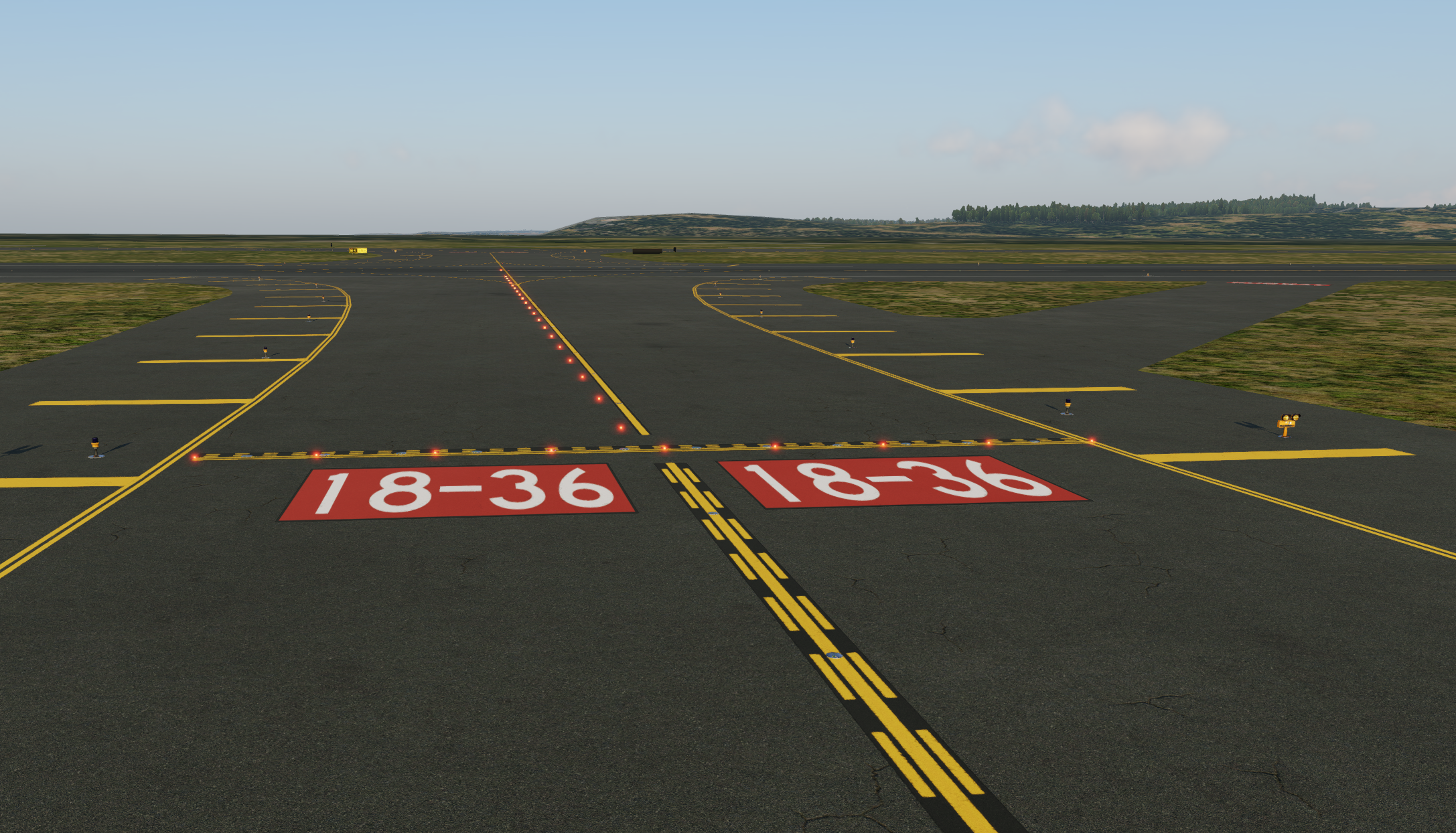
A row of red in-pavement lights running from the holding position — usually the CAT I one — along the taxiway and onto the runway. It marks the path an aircraft takes to enter, and warns you not to enter or cross. Where the taxiway splits toward the runway, the row runs down the center of the split.
How the row is laid down:
- Offset from the taxi centerline.
- It ends automatically at the runway edge.
- A final light is placed offset onto the runway centerline.
| State | Meaning |
|---|---|
| Red | Do not enter or cross — there is traffic on the runway, or about to be. |
| Dark | Nothing is coming. There is no green state. |
How REL differs from the other lights:
- Stop bars lie across the taxiway and a controller switches them.
- REL runs along your path onto the runway and is automatic.
- THL is on the runway centerline, for an aircraft already lined up.
What lights an REL row¶
- An arrival inside its approach window — roughly the last 30 seconds to the threshold.
- A departure rolling, or a landing aircraft rolling out, that has not yet passed your entrance.
- An aircraft crossing the runway at your entrance.
The rows release themselves a couple of seconds before the traffic reaches you — the moment a controller would say "cross behind." So a row going dark as an aircraft passes is normal, not a glitch.
Where REL shows¶
- In both X-Plane and MSFS.
- Only while connected to VATSIM and below 1,000 ft AGL — the same gate as the stop bars.
- Only where the airport has published REL rows for the scenery you fly.
- REL rows are drawn by contributors, entrance by entrance.
- They are separate from the stop bars — an airport can have bars and no REL.
- See Mapping REL rows.
- Only when a controller has claimed REL for that runway.
- Like THL, the lights come from the controller's ground-radar picture.
- With nobody holding that runway's REL you see none.
- That absence is not an all-clear.
REL is armed, then runs itself
A controller claims REL on a runway; the monitor then drives every row on it automatically. REL is EuroScope-only — see the EuroScope REL section.
Further reading — RWSL in the real world
XPGuard's THL and REL follow the Runway Status Lights (RWSL) system. RWSL is an ICAO-recognised runway-safety concept operated in the real world by EUROCONTROL and the FAA:
Follow the Greens (FTG)¶
A trail of green taxiway centerline lights a controller switches on to lead you along your cleared taxi route. You taxi by following the greens.
How it works:
- Controller-driven and VATSIM-only. You never start FTG yourself.
- A controller draws your route on the radar and sends it.
- You get a request popup naming them. Accept it.
- The greens light along your route, starting at your aircraft. Follow them.
- They retract behind you as you taxi.
- By default they keep only a short stretch lit — a moving window a little behind and a good way ahead — sliding along with the aircraft.
- A controller can instead light the whole route at once.
- The greens hold short at red stop bars.
- Where the lit line ends is where you hold.
- They continue on their own when the bar is switched off.
- They never light green past a lit red bar.
A dark centerline or a red bar means stop
Follow the lit greens; where they end, you hold. As with every other light, your taxi clearance comes from ATC.
FTG needs a published taxi network, so it is not available at every airport yet. It also needs a controller who offers it. If nothing lights, that is normal.
Green brightness is set separately from the red lights in your sim's panel.
More detail:
- Per-sim behavior (accepting a request, the active-session card, scenery alignment) is on the X-Plane and MSFS pages.
- The controller workflow is on the EuroScope page. FTG is EuroScope-only on the controller side.